Why Are We So Hard on Ourselves?
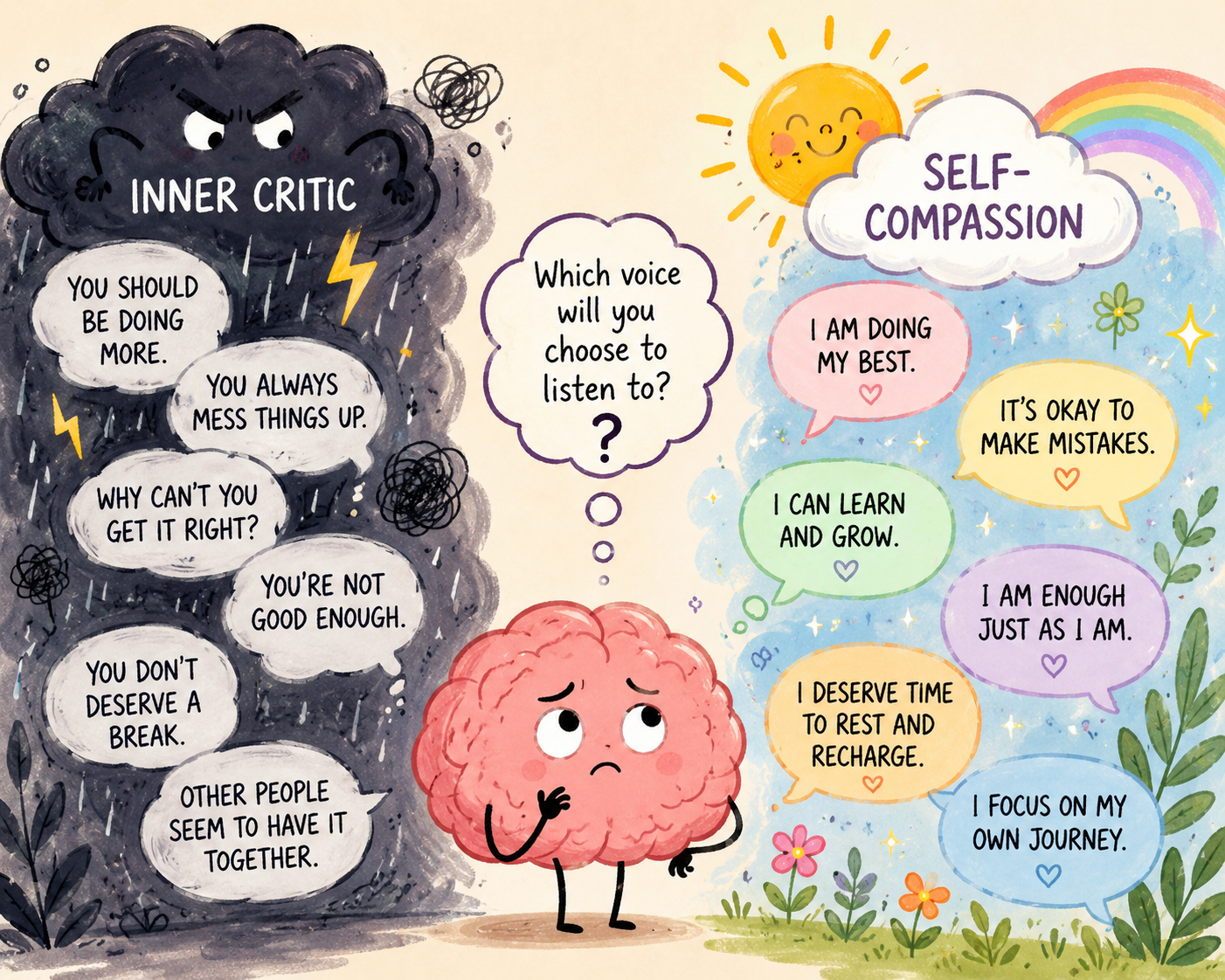
Have you ever noticed that the way you speak to yourself can be very different from the way you would speak to someone you care about?
When it comes to our friends, family, colleagues and peers, we can often offer kindness, compassion and patience. Yet when it comes to ourselves, our inner voice can be harsh, critical, demanding and unforgiving.
You might find yourself thinking:
I should be coping better.
I'm overreacting.
I'm too sensitive.
Everyone else seems to manage.
I'm just not enough.
Sometimes our external experiences can reinforce these negative beliefs about ourselves. For example, your inner narrative may already be telling you, "I'm not good enough." Then perhaps a friendship ends, or you experience rejection at work. Instead of seeing it as one difficult experience, your inner critic uses it as evidence that the belief must be true: "They left me, so that proves I'm not enough."
Over time, these thoughts can become so familiar that we stop questioning them. They begin to feel like facts rather than opinions.
The more we hear a thought, the more believable it can become. Even when there is little evidence to support it, our brains naturally look for information that confirms what we already believe. This can make it feel as though our inner critic is telling us the truth, when in reality it's only telling one version of the story.
Most of us have an inner critic to some degree. The difference is not whether it's there, but how loud it has become and how much influence it has over our daily lives.
Where Does Self-Criticism Come From?
Our inner critic rarely appears out of nowhere.
It may have developed through childhood experiences, high expectations, difficult relationships, workplace pressures or life events that taught us we had to be perfect, strong or constantly achieve in order to be accepted.
Sometimes being hard on ourselves developed as a way of staying safe or motivated. What may once have helped us cope or survive, however, may no longer be helping us thrive.
The Cost of Constant Self-Criticism
Living with a harsh inner voice can be exhausting.
It can contribute to:
Anxiety
Low self-esteem
Perfectionism
Burnout
Feeling like you're never "good enough"
Difficulty accepting compliments or recognising your achievements
Self-sabotaging opportunities because you don't feel you deserve them
Even when life appears to be going well, self-critical thoughts can stop us from fully enjoying it.
How Can We Navigate This?
One helpful starting point is to gently question the thoughts we have about ourselves.
A small shift in perspective can help us recognise when we're being much harder on ourselves than we would ever be towards someone else.
This is a question I often encourage people to consider:
If your closest friend came to you feeling overwhelmed after making a mistake, convinced they always get things wrong and that they weren't good enough... what would you say?
Would you agree with them?
Would you tell them they're a failure?
Would you remind them of every mistake they've ever made?
Probably not.
More likely, you would offer understanding, encouragement and reassurance. You would remind them that one difficult experience does not define who they are.
The challenge is learning to offer some of that same compassion to yourself.
A Small Exercise to Try This Week
The next time you notice a self-critical thought, write it down. Then ask yourself:
Is this a fact or an opinion?
What evidence supports this thought?
What evidence doesn't support this thought?
If a friend said this about themselves, what would I say to them?
You don't have to force yourself to think positively. Simply becoming curious about your thoughts is often the first step towards changing them.
Self-Compassion Isn't Self-Indulgence
Many people worry that if they stop criticising themselves, they'll become complacent or stop trying.
In reality, self-compassion often helps us become more resilient. It allows us to recover from setbacks without becoming trapped in shame or self-blame.
It's okay to slow down, acknowledge that you're struggling and recognise that something isn't feeling quite right.
Being compassionate towards yourself doesn't mean avoiding responsibility. It means recognising that you're human, that everyone struggles sometimes, and that mistakes don't define your worth.
In fact, treating yourself with the same kindness you naturally show others can help build the confidence and resilience that makes it harder for your inner critic to take over.
How Counselling Can Help
Counselling provides a safe, non-judgemental space to explore the stories you've been telling yourself for years.
What is your inner narrative?
What are you repeatedly telling yourself that may not actually be true?
How can we begin to gently question and challenge those beliefs?
Together, we can explore where those beliefs came from, whether they're still serving you, and how you might begin to develop a kinder, more balanced relationship with yourself.
This isn't about being positive all the time. It's about learning to speak to yourself with the same understanding and compassion that you so readily offer to others.
A Gentle Thought to Leave You With
The next time you notice your inner critic becoming louder, pause for a moment and ask yourself:
"Would I say this to someone I care about?"
If the answer is no, perhaps you deserve a kinder response too.
How can you gently reframe what your inner critic is saying?
Learning to treat yourself with compassion doesn't happen overnight. It takes time to recognise those familiar patterns, and it takes patience to create new ones.
With gentle support, it is possible to quieten your inner critic and build a more compassionate relationship with yourself. Counselling can help you notice those patterns, challenge them, and begin writing a kinder story about who you are.
Your inner critic may have had the loudest voice for a long time, but it doesn't have to have the final say.
